Dissimilar Metal Joints
Stainless steel to carbon steel, low-alloy steel, mild steel and cast steel transitions.

The 23Cr/13Ni low-carbon stainless electrode engineered for joining stainless steel to carbon steel and low-alloy steels, and for high-temperature equipment such as furnaces and exhaust systems. Dilution tolerance and crack resistance make E309L the preferred choice for dissimilar joints and buffer layers.
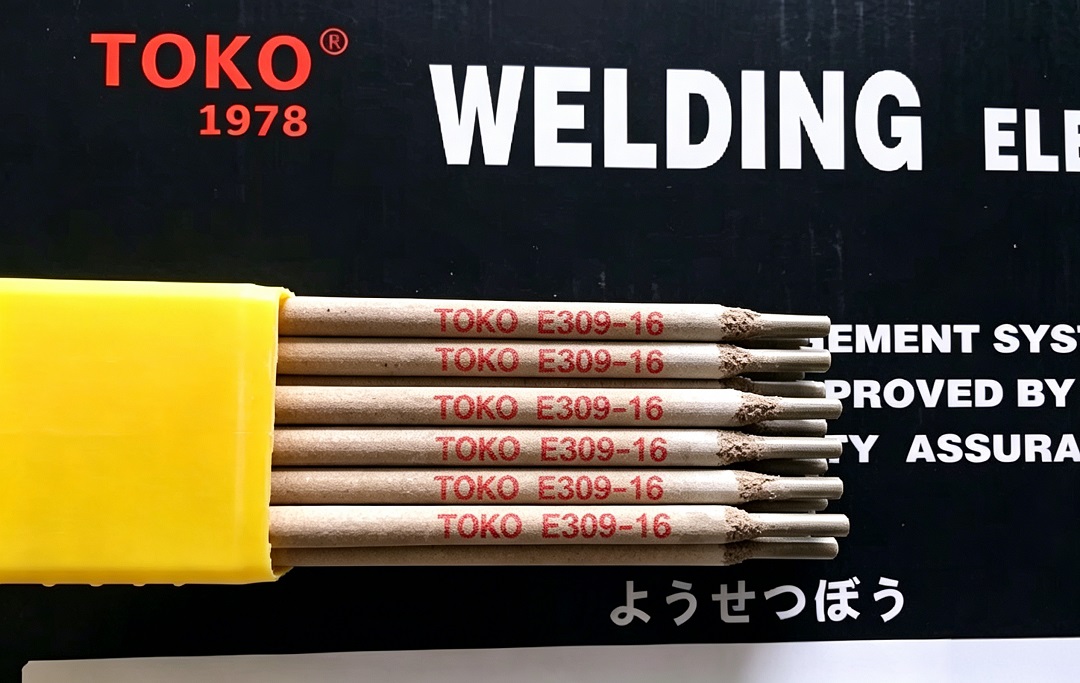
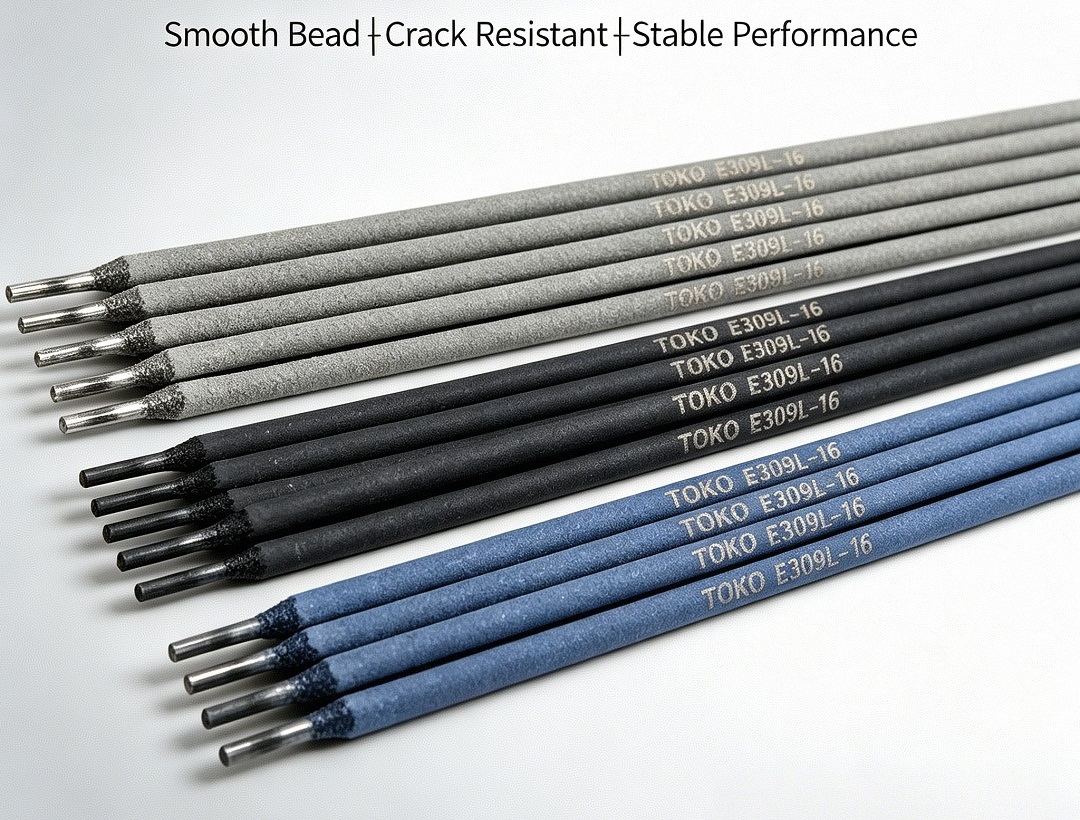
TOKO E309L-16 is a rutile-coated, low-carbon stainless steel stick electrode with a 23Cr/13Ni chemistry designed for welding dissimilar metals — joining austenitic stainless steels to carbon steel, low-alloy steel, mild steel or cast steel. It is also widely used for high-temperature equipment such as furnaces and exhaust systems, and for cladding/overlaying carbon steel to improve corrosion resistance.
Not sure which stainless steel electrode fits your application? The table below summarises the differences between the three most common austenitic stainless steel electrode grades.
| Feature | E309L-16 | E308L-16 | E316L-16 |
|---|---|---|---|
| Base Metal | Dissimilar joints | 304 / 304L stainless | 316 / 316L stainless |
| Chemistry | 23–25% Cr, 12–14% Ni | 18–21% Cr, 9–11% Ni | 17–20% Cr, 11–14% Ni, 2–3% Mo |
| Key Property | Dilution tolerance, dissimilar welding | Low carbon, general corrosion resistance | Molybdenum-enhanced pitting resistance |
| Typical Applications | Stainless to carbon steel, cladding, furnaces | Food equipment, chemical tanks, 304L piping | Marine, pharmaceutical, chemical processing |
| Max Service Temp. | ~300 °C continuous | ~400 °C continuous | ~400 °C continuous |
Full chemical composition, mechanical properties, welding parameters and storage guidelines for TOKO E309L-16 dissimilar metal electrode.
| Element | Value (%) |
|---|---|
| Carbon (C) | ≤ 0.03 |
| Chromium (Cr) | 23.0 – 25.0 |
| Nickel (Ni) | 12.0 – 14.0 |
| Manganese (Mn) | 0.5 – 2.5 |
| Silicon (Si) | ≤ 1.0 |
| Phosphorus (P) | ≤ 0.040 |
| Sulfur (S) | ≤ 0.030 |
| Molybdenum (Mo) | ≤ 0.75 |
| Property | Value |
|---|---|
| Tensile Strength (MPa) | ≥ 550 (typical 580–640) |
| Yield Strength (MPa) | ≥ 350 |
| Elongation (%) | ≥ 25 |
| Hardness (HB) | ~ 180 |
| Ferrite Content (FN) | 10 – 20 (typical 15) |
| Diameter (mm) | Current (A) | Voltage (V) |
|---|---|---|
| 2.5 | 60 – 90 | 21 – 24 |
| 3.2 | 80 – 120 | 22 – 26 |
| 4.0 | 110 – 160 | 24 – 28 |
DCEP (DC+) recommended for optimal arc stability. Preheat generally not required for thin sections; maintain interpass temperature ≤ 150 °C to avoid hot cracking.
| Condition | Requirement |
|---|---|
| Unopened packaging | Store in dry place (< 60% RH) |
| Opened electrodes | Use within 8 hours, or hold at 100–150 °C |
| Re-drying (if damp) | 250–300 °C for 1 hour |
Store in original hermetically sealed packaging. Moisture ingress can cause porosity and reduce corrosion resistance.
Trusted in petrochemical, power generation and process industries for critical dissimilar joints and high-temperature service.
Stainless steel to carbon steel, low-alloy steel, mild steel and cast steel transitions.
Furnaces, exhaust systems, heat exchangers and kiln components.
Buffer layer for stainless cladding or overlaying of carbon steel for corrosion resistance.
Reactors, pressure piping and storage vessels in mixed-material construction.
Boiler components, turbine housings and heat-exchanger transition joints.
Food-grade equipment and sanitary piping where dissimilar joints are required.
E309L-16 is designed for dissimilar metal welding — joining austenitic stainless steels to carbon steel, low-alloy steel, mild steel or cast steel. It is also widely used for high-temperature equipment such as furnaces, exhaust systems, and for cladding/overlaying carbon steel to improve corrosion resistance.
E309L contains higher chromium (23–25%) and nickel (12–14%) than E308L (18–21% Cr, 9–11% Ni). This higher alloy content provides tolerance to dilution from the carbon steel side of the joint, prevents martensite formation and reduces cracking risk — making E309L the preferred choice for dissimilar joints and buffer layers.
Yes. E309L-16 is frequently used as a buffer layer when cladding or overlaying carbon steel with stainless steel. The 23Cr/13Ni chemistry tolerates dilution, and the low carbon content (≤ 0.03%) minimizes carbide precipitation.
E309L welds are typically used for continuous service up to about 300 °C. Above this temperature, oxidation resistance decreases and higher-alloyed electrodes (such as E310 or nickel-based grades) should be considered.
Standard MOQ is one pallet (approximately 1–2 tons). Typical production lead time is 15–25 days for stock grades and 25–35 days for custom packaging or private-label orders. Free samples are available for qualified buyers.
Tell us your base materials, welding position, standard and monthly volume. Our welding engineers will recommend the right diameter and confirm dilution tolerance, and send a full quotation with mill certificates and shipping options.
Download batch-specific material certificates, safety data sheets and welding procedure guidelines. All certifications are third-party verified and comply with AWS A5.4 / ASME SFA-5.4.