TOKO AWS A5.1 E6011 Cellulose Potassium Welding Electrode
Cellulose-coated electrode designed for single- and multi-pass welding of carbon steel. Combines a forceful digging arc, deep penetration, and all-position capability, making it the preferred choice for pipeline welding, structural erection, and repair work on contaminated surfaces.
Key Advantages
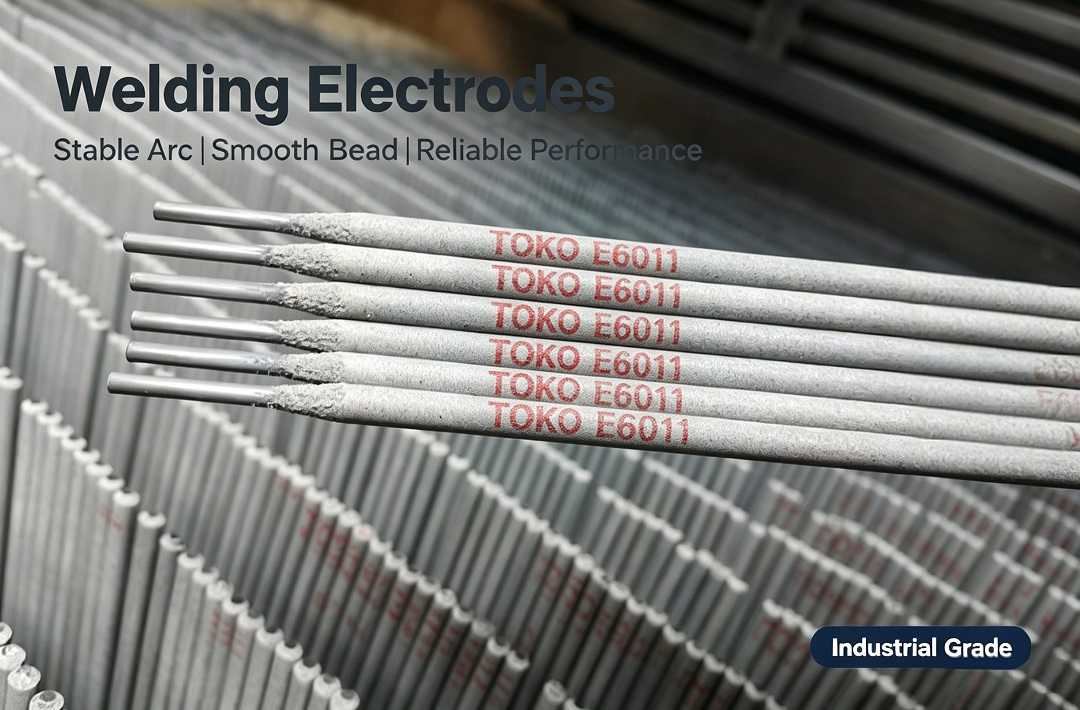
- AWS A5.1 / SFA-5.1 compliant — full traceability and certified mechanicals.
- Cellulose potassium coating — provides forceful digging arc, ideal for root penetration.
- All-position capability — flat, horizontal, vertical-up, vertical-down, and overhead.
- Exceptional contaminant tolerance — welds through rust, paint, oil, and mill scale.
- AC or DC+ operation — versatile for field generators or shop rectifiers.
- Available diameters: 2.5mm (3/32"), 3.2mm (1/8"), 4.0mm (5/32").
Performance Benefits for Pipeline & Structural Welding
- Arc Force: Powerful, penetrating arc ensures root fusion in open-root joints.
- Fast-Freeze Slag: Rapid solidification supports vertical-down and overhead welding.
- Slag Removal: Thin, friable slag lifts easily, reducing cleaning time.
- Surface Tolerance: Ideal for field repairs where grinding is impractical.
- Versatility: Works on galvanized, painted, or slightly rusty steel.
E6011 vs. E6013: Key Differences
| Feature | E6011 (Cellulose) | E6013 (Rutile) |
|---|---|---|
| Arc Characteristic | Forceful, digging, deep penetration | Soft, smooth, shallow to medium penetration |
| Penetration | Deep (ideal for root passes) | Shallow (ideal for sheet metal) |
| Position Capability | Excellent in vertical-down, overhead | Good in all positions, easier vertical-up |
| Surface Tolerance | High (rust, paint, oil) | Moderate (light rust okay) |
| Typical Applications | Pipeline, structural, repair | General fabrication, sheet metal, hobby |
| Skill Level | Intermediate / Professional | Beginner / General purpose |
Primary Industrial Applications
Trusted by pipeline contractors, structural fabricators, and maintenance crews worldwide.
Pipeline Welding
Root, hot, fill, and cap passes on cross-country pipelines. Excellent for vertical-down progression.
Structural Steel
Field erection of beams, columns, and trusses where surfaces may have mill scale or light rust.
Heavy Equipment Repair
Mining, construction, and farm machinery repair — grinds through oil-soaked surfaces.
Shipbuilding & Marine
Hull repairs, deck fittings, and offshore structures where wind and surface prep are challenging.
Additional Applications
- Storage tank fabrication
- Galvanized steel welding
- Railcar repair
- Field maintenance & repair
- Bridge construction (non-critical)
Technical Specifications
Chemical Composition (Typical, Weld Metal)
| Element | Value (%) |
|---|---|
| Carbon (C) | 0.07 – 0.15 |
| Manganese (Mn) | 0.50 – 0.90 |
| Silicon (Si) | 0.15 – 0.30 |
| Phosphorus (P) | ≤ 0.025 |
| Sulfur (S) | ≤ 0.020 |
Mechanical Properties (As-Welded)
| Property | Value |
|---|---|
| Tensile Strength (MPa) | 410 – 560 |
| Yield Strength (MPa) | ≥ 330 |
| Elongation (%) | ≥ 22 |
| Charpy V-notch @ -20°C (J) | ≥ 27 (typical 40-60) |
Welding Parameters (AC/DC+)
| Diameter (mm) | Current (A) All-Positions | Current (A) Flat/Horizontal |
|---|---|---|
| 2.5 | 60 – 100 | 70 – 110 |
| 3.2 | 80 – 120 | 90 – 140 |
| 4.0 | 120 – 160 | 140 – 200 |
DC+ (reverse polarity) gives most stable arc; AC suitable with sufficient open-circuit voltage.
Storage & Re-drying
| Condition | Requirement |
|---|---|
| Unopened packaging | Store in dry place (<60% RH) |
| Opened electrodes | Use within 8 hours or store in holding oven at 80-120°C |
| Re-drying (if damp) | 250-300°C for 1 hour |
Certifications & Technical Docs
Download batch-specific material certificates, SDS, and welding procedure guidelines.
All certifications are third-party verified and comply with AWS A5.1 / ASME SFA-5.1.