
TOKO E71T-9CJ Low Hydrogen Flux-Cored Welding Wire
Premium low hydrogen, CO₂ gas-shielded wire delivering exceptional ultra-low temperature toughness (-60°C) and mechanical properties for critical mild steel and HSLA fabrication. Trusted for arctic offshore, cryogenic storage, and seismic-resistant structures worldwide.
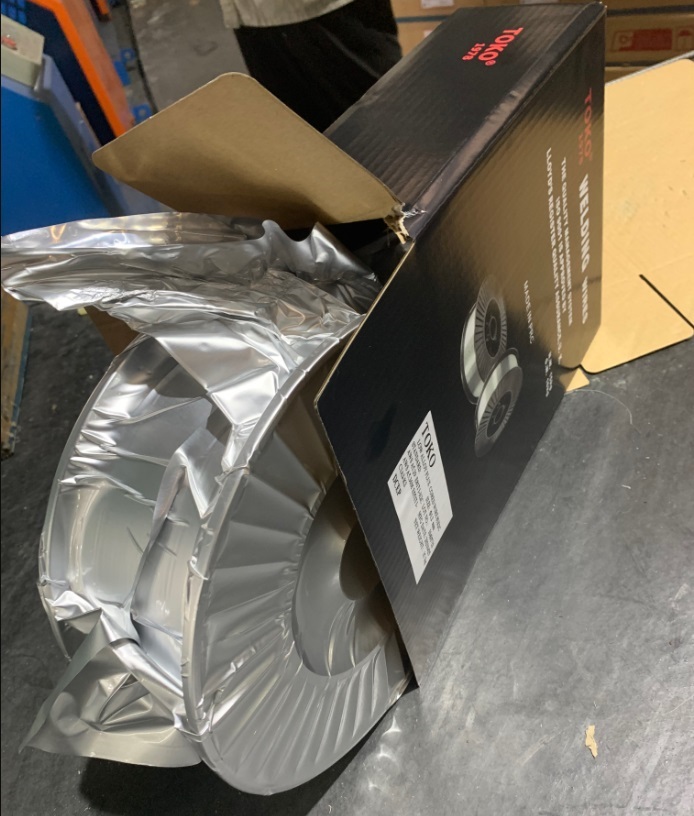
Key Advantages
- AWS A5.20 / A5.36 compliant — full traceability and certified mechanicals, including the stringent "J" designation for enhanced low-temperature toughness.
- Optimized for 100% CO₂ (20–25 L/min) — excellent arc stability, deep penetration, and cost-effective shielding.
- Ultra-low hydrogen design — diffusible hydrogen ≤4 ml/100g, minimizing risk of hydrogen-induced cracking in restrained joints and thick sections.
- Exceptional low-temperature toughness — guaranteed Charpy V-notch impact values ≥40J at -60°C, ideal for arctic and cryogenic service.
- All-position capability — flat, horizontal, vertical-up, and overhead with smooth bead profile.
- High deposition rates & low spatter — boosts productivity and reduces post-weld cleaning.
- Available diameters: 0.9mm (0.035"), 1.2mm (0.045"), 1.6mm (1/16").
Performance Benefits for Critical Low-Temperature Applications
- Arc Stability: Smooth, consistent arc with minimal fumes, even at low amperages.
- Weld Appearance: Fine ripple, excellent wetting, minimal undercut.
- Slag Release: Self-peeling or light chipping for easy cleaning.
- Toughness: Superior CVN at -60°C meets the most demanding specifications (e.g., offshore, arctic).
- Hydrogen Control: Low hydrogen formulation meets critical fabrication requirements.
E71T-9CJ vs. E71T-5C vs. E71T-1C: Which One Fits Your Project?
All exceed AWS requirements, but E71T-9CJ offers the highest toughness for extreme environments.
❄️ E71T-9CJ (Low Hydrogen / High Toughness)
- Slag: Basic (fluoride), ultra-low hydrogen
- Transfer: Spray/globular, deep penetration
- Key Feature: Exceptional toughness @ -60°C (≥40J)
- Best for: Arctic offshore, cryogenic, seismic, critical HSLA
- Hydrogen: ≤4 ml/100g
🔸 E71T-5C (Basic / General Purpose)
- Slag: Basic (fluoride), good toughness
- Transfer: Spray/globular, deeper penetration
- Key Feature: Good low-temp toughness @ -20°C (≥47J)
- Best for: Offshore, structural, general low-temp
- Hydrogen: Low, but not as critical as 9CJ
🔹 E71T-1C (Rutile / General Fab)
- Slag: Rutile-based, fast freezing
- Transfer: Fine spray, very low spatter
- Key Feature: Excellent operator appeal, general fab
- Best for: Structural steel, shipbuilding, bridges
- Impact: 27J @ -20°C (standard)
Primary Industrial Applications
Proven in the harshest environments: from Arctic pipelines to North Sea platforms.
Arctic & Subarctic Construction
Structures, pipelines, and facilities in extreme cold climates where -60°C toughness is mandatory.
Offshore & Marine
Jack-up rigs, FPSOs, modules — preferred for low-temperature toughness and hydrogen control.
Cryogenic Storage
LNG tanks, pressure vessels, and piping requiring exceptional notch toughness at sub-zero temperatures.
Seismic-Resistant Structures
High-rises, bridges, and critical infrastructure where ductility and toughness are paramount.
Additional Applications & Industries
- High-strength low-alloy (HSLA) steel fabrication (A572, A588, A709)
- Shipbuilding (ice-class vessels, Arctic class)
- Pressure vessel and boiler fabrication
- Wind turbine towers in cold climates
- Heavy equipment for mining in cold regions
- Pipeline girth welds requiring low-temperature toughness
- Penstocks and hydroelectric infrastructure
Technical Specifications (Typical)
Chemical Composition (%, single values are max)
| C | Mn | Si | S | P | Ni | Cr | Mo | Al |
|---|---|---|---|---|---|---|---|---|
| ≤0.08 | 1.00–1.80 | 0.40–0.80 | ≤0.010 | ≤0.015 | 0.40–1.00 | ≤0.15 | ≤0.25 | 0.80–1.40 |
Mechanical Properties (as-welded, 100% CO₂)
| Property | Value |
|---|---|
| Tensile Strength (MPa) | 550–650 |
| Yield Strength (MPa) | ≥430 |
| Elongation (%) | ≥24 |
| Charpy V-notch @ -40°C (J) | ≥60 |
| Charpy V-notch @ -60°C (J) | ≥40 (typical 50-70) |
| Diffusible Hydrogen (ml/100g) | ≤4 |
Recommended Welding Parameters (1.2mm / 0.045")
| Position | Current (A) | Voltage (V) | Stick-out (mm) | Gas Flow (L/min) |
|---|---|---|---|---|
| Flat/Horizontal | 200–280 | 26–30 | 15–20 | 20–25 |
| Vertical Up | 150–200 | 23–26 | 12–18 | 20–25 |
| Overhead | 140–180 | 22–25 | 10–15 | 20–25 |

Storage & Re-drying (Critical for Low Hydrogen)
| Condition | Requirement |
|---|---|
| Unopened packaging | Store in dry place (<40% RH recommended) |
| Opened spools | Use within 2-4 hours or store in holding oven at 120-150°C |
| Re-drying (if exposed) | 250-300°C for 1 hour |
Important: Maintain low hydrogen practice. Handle with clean gloves. Discard if contaminated.
Certifications & Technical Docs
Download batch-specific material certificates, SDS, and welding procedure guidelines.
All certifications are third-party verified and comply with AWS A5.20 / A5.36.